Do You Need an Art Degree to Do Art
Education isn't cheap. The increasing professionalization of the art globe ways getting a caste is an increasingly desirable path for many immature artists, merely the levels of debt that come with the pursuit of knowledge makes this option only viable for some. The question is: Tin you become a successful artist without a caste from Yale or the Majestic College of Art?
In that location are very proficient examples of successful contemporary artists who accept side-stepped the academic route. Carsten Höller and Yoko Ono did non nourish art schoolhouse, Jeremy Deller studied art history rather than fine fine art, and Tosh Basco—aka boychild—started out in the underground club scene before working with their partner Wu Tsang and friend Korakrit Arunaanondchai. All these artists managed to embed themselves within the networks of the art globe. They exhibited. They spoke the language.
American-Belgian artist Cecile B. Evans trained as a method actor before entering the art world, and their unique perspective helped in the shift, says their gallerist, Emanuel Layr. "Cecile was restless in understanding the identify of an artist," he explains. "It is exciting to come across them moving in between media—sometimes equally a movie director."
Nonetheless, Layr is a supporter of an arts education—if you have the correct teachers. "I recollect it can be actually corking if at that place's a potent connection to a mentor or someone who really gives y'all guidance in the beginning," he says. "Just how many artists really take such a cracking situation with a professor?" And in many countries, art school is expensive. Amassing $50,000 in debt when you have no guarantee of a job at the finish tin be a terrifying prospect. As Layr points out, committing to a career in the arts "still is a grade question."
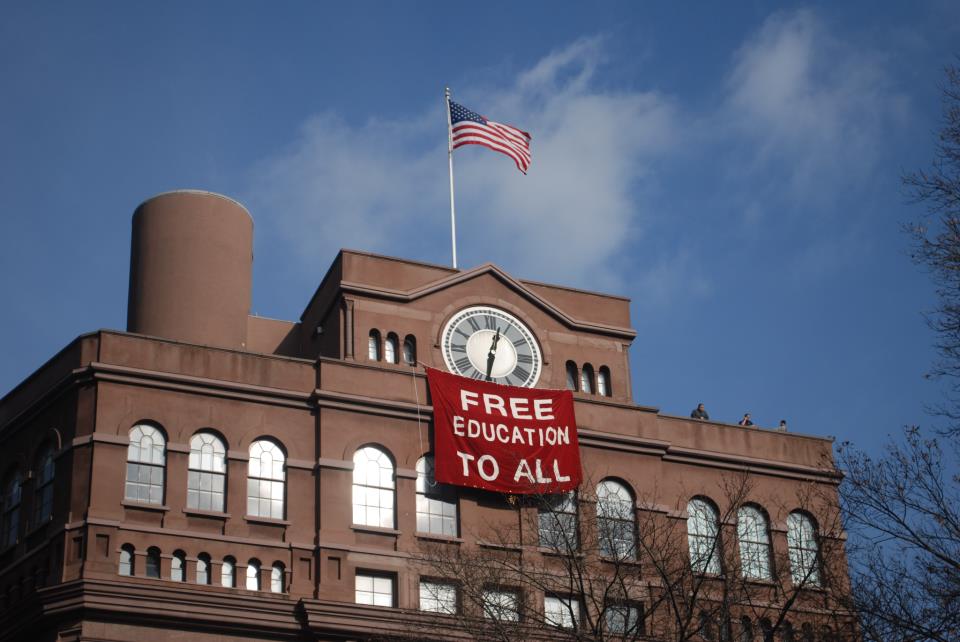
Students hang banner below the historic clock tower at Cooper Union in New York City during a 2012 occupation protesting implementing tuition in the historically gratis schoolhouse. Photo by Free Cooper Union, Creative Eatables Attribution-Share Alike 3.0 Unported license.
The loftier cost of art school became even more pronounced during the pandemic, when many art schools were unable to offering the usual elements of a caste grade, like group critiques, studio fourth dimension or access to communal equipment—let alone the social interaction. "Students were very disempowered and disenfranchised past the lockdown and understandably really upset," says Peter Davies, a painter who shows with The Arroyo and teaches at the Slade School of Art in London. "They were conscious of being consumers and of having paid a very considerable amount in fees, but not getting the feel they were expecting. During lockdown, fine fine art courses weren't even able to provide studio space, with all activeness existence online. This was hugely problematic."
Arguably, students' frustrations are a sign of a generational shift around the idea of arts education itself, with it being seen every bit a service beingness paid for rather than an investment towards futurity success that might not pay off quickly. "The cost of living, and the cost at present of university education, ways many potential students who are likewise potentially amazing artists are being put off studying fine art, since it won't lead to a reasonable salaried task, in the way other university courses might."
Despite this, Davies is vocal about the importance of an teaching as a way to prepare young artists for the wider world. And some recent Slade BFA graduates, such as Zeinab Saleh and Danielle Brathwaite-Shirley, already have strong institutional and gallery presences, despite non having a college degree, he says. In fact, many are foregoing postgraduate programs. Artists without MFA degrees, like Rhea Dillon, who studied fashion communications for her BA from Key Saint Martins fine art school in London, and Phoebe Collings-James, accept all found notable success.
Mayhap the biggest do good of art school might be the connections students make there. Sebastian Lloyd Rees went to Goldsmiths for his BA, where he met Ali Eisa and formed Lloyd Corporation, an ongoing collaborative practice making installation and performance fine art. Rees also works independently as a painter, which he started after completing his degree. "Knowledge is one of the biggest factors to evolution and to push yourself forwards. But is going to fine art schoolhouse going to make y'all become an artist, when you graduate? Unfortunately non. I really don't think and then," he says. "If I expect back at Goldsmiths, as an institution, what it really did for me was to start a collaboration."
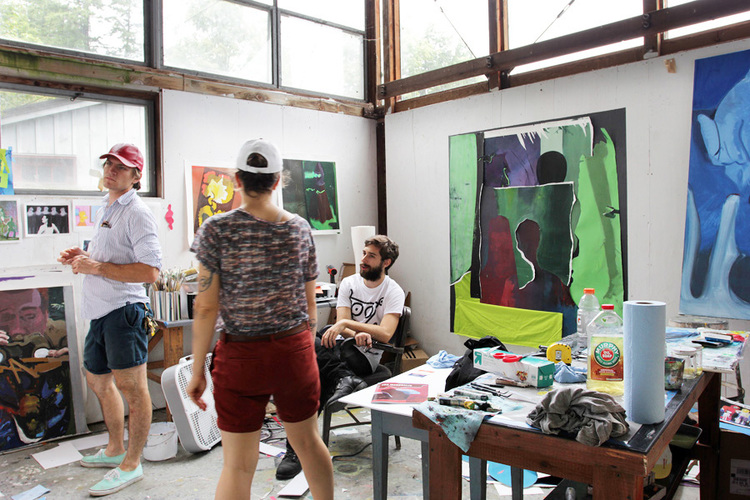
Residents in the studio infinite at Skowhegan. Image courtesy of Skowhegan Schoolhouse of Painting and Sculpture.
Rees as well offers some of import questions those thinking almost going to fine art schoolhouse should ask before applying to a specific schoolhouse: How many people are taking the course? How much time do you actually get to speak to your tutor?
As the popularity of arts programs has grown over the past decade, a flurry of culling fine art schools emerged, demonstrating the potent want for an affordable arts educational activity exterior of the established institutional structures. Bruce High Quality Foundation notably ran a gratis schoolhouse in New York for a few years, with open lectures and workshops. Open up School Eastward in the Britain was established in 2013 as "an contained free art school" with a focus on "emerging practitioners of different generations, with or without a BA, MA or formal qualification," according the awarding website. Alumni include the artists Lucy Beech and Paul Maheke Ngamaha.
Some other interesting alternative projection is the University of the Undercover, established in 2017 and based between nightclubs in Amsterdam and London. Its founder, artist Nelly Ben Hayoun-Stépanian, describes the non-profit every bit an advancement network for free artistic and transnational education, where students work with established institutions from Deliveroo to the United Nations on a slate of collective performances, activist events and installation projects. "The core idea of the University of the Hugger-mugger is the issue or the experience as the starting point of a chat betwixt nightlife creators and public institutions," she says.
The student body is made up of nightlife artists, sex workers, poets, and other fine art schoolhouse graduates. "We try to invest as much as possible in young people, like historic period 21," she says. "They come up from all different backgrounds—in general, I would say from underrepresented backgrounds, people that don't fit the normal bookish bill."
Hayoun-Stépanian, who has a PhD in human geography and political philosophy, is yet aware of the importance of instruction on a CV. But she argues that in gild for institutions similar the educational activity organisation to be decolonized, experimental approaches are necessary. "In club for mainstream education to evolve, a radical new model must accept identify," she says.
The fundamental issue at manus is what purpose an arts education is meant to serve. If you are looking for a return on a hefty investment in the class of a guaranteed flourishing career, so arts school will probably disappoint y'all. Art schools could too be seen equally a training footing where artists learn to produce the almost appealing and saleable commodities for the marketplace or institutional system, which is dominated by individual interests and cultural norms. Withal, yous could likewise view fine art schools as some of the last spaces where intellectual stimulus persists and other forms of thinking can emerge.
So, art schoolhouse is either the final bastion of cultural resistance against capitalist power—or a way of assimilating dissent into a readily consumable package. Either mode, you can find success without information technology.
Follow Artnet News on Facebook:
Want to stay ahead of the art earth? Subscribe to our newsletter to get the breaking news, heart-opening interviews, and incisive disquisitional takes that drive the conversation forward.
pettigrewprephred.blogspot.com
Source: https://news.artnet.com/art-world/ask-experts-go-art-school-can-become-successful-artist-without-2034321
0 Response to "Do You Need an Art Degree to Do Art"
Post a Comment